


Memories of a trip I made to the holy South Indian pilgrimage town of Tiruvannamalai in the state of Tamil Nadu where I stayed at the Athithi Ashram which is run by devotees of the great twentieth century spiritual master Bhagavan Sri Ramana Maharshi. The resident teacher of Athithi Ashram is Swami Hamsananda, with whom it is possible to sit and meditate with each morning as well as engage in conversation about the life of Bhagavan, the practice of meditation, and the spiritual paths of bhakti (devotion) and Jnana (self-enquiry) in the form of asking the question – Who Am I?
What is described below is intended to complement those themes found within Journey To Ramanasramam.
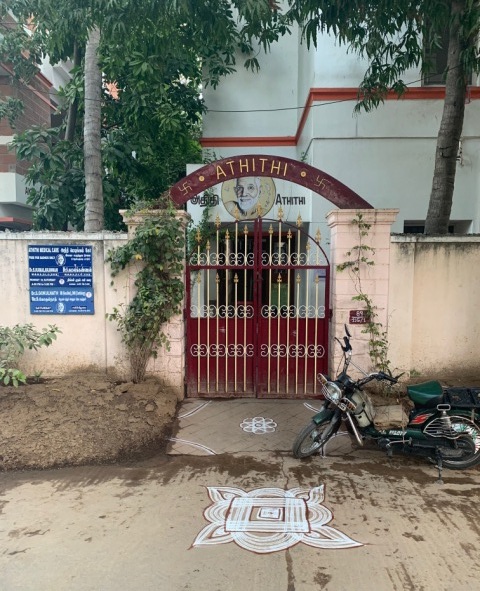
When I arrived at the Athithi Ashram after my taxi ride from Chennai I opened the gates, took off my shoes and put them on the shoe stand because no footwear was allowed to be worn in the ashram grounds. Then I went to the small ashram office on the left hand side within the ashram compound and which had a couple of desks and computers in it, as well as some chairs for people to sit on. A gentle, mild mannered man dressed in white cotton clothes checked me in after I’d filled out all the necessary forms, given him my passport details and taken a photograph of myself with my mobile phone which I then emailed to him on the spot. The room I was given was in the block above the office and I guess that the block must have had nine or ten rooms which were spread over three floors. Mine was on the top floor where there were three other rooms, all of which seemed to be occupied.
Stepping inside my room for the first time I saw it had a single bed with a very firm mattress and a pillow with a thin sheet on top of it, so I guess it was just as well the weather was hot and that I would not be needing a blanket. There was a table and chair in the corner of the room next to the window and some shelves built into the wall, upon which I could put my clothes once I’d unpacked my case and stashed it under my bed. On the wall opposite to the side of the room my bed was on there was a framed and mounted colour portrait of Ramana Maharshi and also one of the holy hill Arunachala. There was a door at the end of my bed which opened up into a bathroom where there was a toilet and shower along with a small basin and mirror. The window in my room had shutters rather than glass with a wire mesh tightly strung across it so as to keep the mosquitoes out, although with the room being on the top floor, hopefully their presence would be minimal. I opened the shutters for some airflow and soon realised the street outside was quite noisy with plenty of sounds rising up from it, primarily sounds of auto rickshaws and honking motorbikes. Later on I was to discover the block my room was in overlooked the entrance to a much larger ashram close by, that of Yogi Ramsuratkumar, which attracted large numbers of people each day from the early morning onwards.

The noise did pose one or two challenges with regard to my meditation during my stay there but there was little I could do about it as all rooms in my block would have had the same problem. From past experience I knew that it was best not to dwell on such things, thereby convincing yourself it was a problem, instead it was better to look for ways of working around it. In this instance the method I came up with over the coming days was to only meditate in my room in the very early morning, something like 5 – 6.30, and the rest of the time use the ashram meditation hall instead. This was located on the top floor of another block at the back of the ashram compound and a bit further away from the street noise outside the ashram walls. It was an arrangement which worked out very well because every day after lunch I would make my way to the meditation hall to stay there until the late afternoon where I would meditate, read, and do some walking around the shrine dedicated to Bhagavan Sri Ramana Maharshi which lay at one end of it. The block in which the meditation hall was located also had rooms on its two remaining floors in which people could stay, as well as being the location of Swami Hamsananda’s living quarters which comprised a couple of rooms on the first floor along with a pleasant balcony where there were ledges and chairs for people to sit on, as well as the floor. Swamiji of course, being the founder of Athithi Ashram.
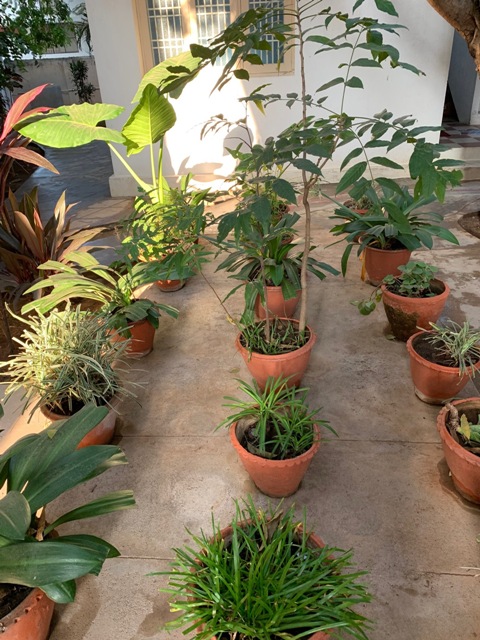
Next to the block my room was in was another block more or less in the middle of the ashram which had a similar number of rooms spread over its three floors but did not seem to have many people staying in it, probably being well under half full. That was one of the things about my 2020 stay in Athithi Ashram, just how quiet it was, something which was in stark contrast to the previous year when it had been packed to the rafters. There was a building opposite the office and to the right of the gates which was largest in the ashram compound and it was comprised of three floors constructed around an inner courtyard. This building housed the ashram kitchens and dining hall, both of which took up the whole of the first floor. On the ground floor and on the top floor were rooms for the ashram staff and long term ashram residents which would have probably included both sadhus and sannyasins. There was also an inner courtyard in which there were plenty of large green plants in the middle of it that had been dug directly into the soil, plants which grew to some considerable height and gave this inside area an attractive ambience, whilst above the plants was the open sky. The only drawback to having all the big plants in the courtyard was that they seemed to attract a lot of mosquitoes and at certain times of the day they made their presence felt, in fact on the ground floor at all times of the day they made their presence felt, where if you had a room you would probably have a hard job keeping them out of it, mesh or no mesh, and would just have to learn to live with them because it really was Mosquito Central.

The dining hall on the first floor was where all the ashram inmates ate the three meals which were served each day at the following times – breakfast at 8.30, lunch at 12.30 and dinner at 8. Meals were comprised of pure vegetarian sattvic food which was always without fail both fresh and delicious. During the course of my stay all my meals were taken in the ashram, with the exception of just a single breakfast and that was on the day I went out early to walk up the holy hill of Arunachala to Virupaksha Cave. On that day I had a large glass of coffee from the Ramana Fresh Coffee and Fruit Juice Stand which was opposite Ramanasramam on the main road before setting out on my hike up the hill. Since the ashram was only half full it meant that on most days the dining hall felt pretty empty, with usually no more than 10 or 12 of us eating there at any one time. It was a less stressful experience than when I’d stayed in Ramanasramam and had my meals there, that was for sure, where on a number of occasions my uncertainty over where I was supposed to sit had caused some considerable degree of agitation in me. It was also different to last year, when apart from a few meals which I ate at Athithi Ashram after the morning satsangs, I was out each day and eating in places such as The Excellent Cafe.
This year when eating my meals in Athithi I sat on a small plastic stool and used a low bench as my table, a bench which I shared each meal time with an orange robed sannyasin who was a large Indian guy probably in his 40’s and who was in mouna – silence – which meant that when he needed to communicate it was by way of hand gestures. Although he never said a single word he seemed a really nice guy and like me he was there for every meal, as well as also being a constant presence at the morning prayers conducted by swamiji in the meditation hall from 6.30 onwards. Later on in the day I would see him in Ramanasramam too, when he would always be sitting on one of the window ledges to the back of the Ramana Maharshi samadhi shrine in the late afternoon, in fact when I did my shrine walking there each day it felt good to know that he was close by. He was a big guy, he was silent, he was on the path, and if I think about him now I can only wish him the very best. Not that there were ever very many words spoken in the dining hall at meal times, because it was the kind of place where meals were eaten more or less in silence with all talk kept to a bare minimum. The main area where people sat on the floor for meals was round the corner to where me and the silent sannyasin were sat on our stools next to the low bench. It was a floor space which could probably accommodate around 20 people and was looked over by a large painted portrait in a wooden frame of Yogi Ramsuratkumar who was seated on a chair and raising his right arm in blessing. Beneath the portrait of the yogi was written –
YOGI RAMSURATKUMAR JAYA JAYA GURU RAYA

Prior to eating we collected our round stainless steel plates and cups from a rack of utensils next to the washing up area and then took our places in order to wait to get served. Once a day at meal times an ashram worker would come around with a ledger in his hand and make a note of our room numbers, as well as to ask us what meals we would be eating there the next day. This was obviously done to maximise efficiency in terms of them knowing how many people they would be catering for and therefore not cooking too much or too little.
There were also set times in the daily schedule of Athithi Ashram for inmates to help themselves to coffee at 6.30 in the morning and to tea at 3.30 in the afternoon. If you wanted to avail yourself of these opportunities to have a hot drink you had to make your way to the inner courtyard of the main building on the ground floor, where a flask was left on a stone seat with small steel cups beside it into which your coffee or tea could be poured. There was also a container full of sugar so that you could sweeten your drink as required, then you could either sit on one of the stone benches around the inner courtyard and enjoy your drink there whilst gazing out over those tall green plants reaching skywards, or you could take it away with you, either to drink outside whilst walking within the ashram grounds, or to simply take back to your room and have it there. It would have been perfect just to sit on one of those benches around the inner courtyard for longer periods of time if it wasn’t for the fact that any time of day or night the mosquitoes would be there, which meant if you weren’t sprayed with repellent you would have almost certainly got bitten more than once or twice, of that there was no question.
When it came to what I did in my room there were of course some of the usual rituals applied in regard to both my reading and meditation. There was the photograph of Bhagavan, in front of which night lights were lit and incense was burning, but apart from the early mornings it was usually too busy from the sounds coming up from the street outside for me to be able to meditate in there to any great degree. Mainly this was due to the noisy scenes taking place around the entrance to the Yogi Ramsuratkumar Ashram where it seemed like there was always something going on. There was also another fact to bear in mind which was that whilst it was pretty hot in my room it was not possible for me to sit there with the fan on because it was one which made a horrible cranking noise when it spun, and the faster it spun the louder the cranking noise became. Just the luck of the draw I guess, but the long and the short of it was that it was better to keep it switched off for as long as I could stand the heat. What this meant in practice was that apart from those early morning hours, my meditation was done either on the balcony in front of Swami Hamsananda’s quarters during the course of his morning satsangs, or in the meditation hall during the afternoons once I had rested in my room for an hour or so after lunch. Reading in my room was fine however, as was a little bit of relaxation by way of lying back on my bed every once in a while to take a breather, but as for the meditation sitting it had to be done somewhere else after it had got light.

As far as my sitting was concerned the ashram meditation hall suited me just fine, in fact I was more than happy because every day throughout the week I had the place to myself, mainly due to the fact the ashram was relatively light on people staying there, also maybe because not everyone knew it was available as a space in which to sit on your own and do some meditation. My only disturbance was when at some point during the course of the afternoon an Indian lady would enter to sweep the floors of the hall and re-arrange various items on the Ramana Maharshi shrine, but even then it was not really a disturbance and didn’t affect my sitting to any great degree. No, by and large sitting in the meditation hall in the afternoons was good, with energy often tight and focused, allowing me to stay on the button. When I’d had enough it was easy to take breaks by way of walking around the shrine and practise a bit of walking meditation whilst moving barefoot on the floors of the hall. Sure there were a couple of sessions in which I was struggled to keep focus, with relief only coming after I’d gone down for my sweet tea at 3.30 and then felt energised enough from the sugar hit to go back up and carry on.
If I were to break down my daily schedule during the course of my week in Tiruvannamalai this time around it went something like this –
5.00 – 5.30 – early morning meditation in my room whilst it was still dark; night light lit in front of my picture of Ramana Maharshi, sweet smell of incense spiralling upwards from the corner of my room, calls to early morning prayer from a Mosque ringing out in the distance, along with all those other early morning sounds which make up life in south India.
6.30 – sweet coffee, precious sweet coffee drunk whilst walking the ashram grounds in the early morning light. Oh how I loved to sip that sweet, sweet coffee!
6.45 – 8.30 – in the meditation hall where Swami Hamsananda recited each morning the 108 verses of Arunachala Akshara Manamalai and other prayers to Bhagavan Sri Ramana Maharshi.
8.30 – breakfast followed by a wander round the ashram grounds taking in the peace of my surroundings and the fact I was deep in the heart of south India where the weather was hot and sunny.
9.30 – 12.30 – satsang with swamiji. Last year the satsangs tended to be in the meditation hall, probably because there were more people staying in the ashram, however this year they took place on the balcony outside his quarters on the first floor of the building where the meditation hall was located on the top floor. If the satsangs with swamiji ended early there was sometimes a late morning meditation on my own in the meditation hall.
12.30 – lunch.
1.00 – 2.00 – resting in my room, a rest which usually took the form of lying on my bed for a while and very occasionally actually crashing out, of reading more of my Ramana Maharshi book bought from the Ashram Book Depot on my very first day, a book by the name of The Silent Power, or of writing some notes whilst sitting at the desk in my room. There might also be listening to a little bit of music.
In this last respect when I arrived in the ashram I had been listening to an album by the name of Blue Eyed Soul by Simply Red which I’d downloaded on Spotify and played a few times on the Shatabdi Express when making my way over from Mysore to Chennai. This trip to India was the first time I was using an iphone and one of the upgrades I have made to my mobile experience was signing up to Spotify which is where Blue Eyed Soul came from. As things turned out I more or less stopped listening to Blue Eyed Soul on my very first day in the ashram, coming to the conclusion that it wasn’t for me, and switched instead to a couple of other new ones which took up all my attention during those times in the day or night when I lay back on my rock hard ashram bed in order to chill out. Both these albums were particularly good to listen to on my headphones in the late evening when the only illumination in my room came from the night light glowing in front of the portrait of Bhagavan Sri Ramana Maharshi. The first was No Geography by The Chemical Brothers which had some great tunes on it such as the title track and another one called Mad as Hell. The other one I got into was Monsters Exist by Oribtal, an excellent effort which brought back memories of those days in the 90’s when I had been heavily into another work of theirs which went by the name of In Sides.

2.15 to 3.30 – meditation in the ashram meditation hall on the top floor of swamiji’s building at the back of the ashram compound. Time which I felt was generally well spent even though on a couple of occasions it was a bit of a struggle for me to stay awake in the heat, but only on a couple, because on the whole sitting up there through the course of those ashram afternoons was pretty good.
3.30 – time for sweet tea when I would wander down to the inner courtyard of the front building and fill a little steel cup with hot chai from the flask left on one of the stone benches next the big green plants reaching skywards. An afternoon sweet tea worked wonders and was equal in terms of enjoyment to those times I’d spent in Ramanasramam, when as an inmate I’d been able to go to the old dining hall each day at 4 pm for a steel tumbler full of hot chai or hot milk.
3.45 – 4.30 – a return to the meditation hall either for more meditation or some reading of my Ramana book.
4.45 – 6.30 – a walk up to Ramanasramam where, after leaving my shoes with the attendant behind the counter of the ashram shoe stand, I would usually first take a look inside the Ashram Book Depot to see if there was anything I wanted to buy, to have it wrapped in a brown paper bag with the receipt inside and which I would then put in my ashram white cotton shoulder bag. After visiting the Ashram Book Depot I would head for the ashram temples, first the Main Temple where the chanting of the Vedas by the Brahmin students of the ashram Veda Patasala would have already started, all of them sitting in rows facing each other in front of the Ramana Maharshi samadhi shrine. I would be in the Main Temple for a session of shrine walkin’; round and round the samadhi shrine joining the other devotees, of which there would often be a considerable number. Shrine walkin’ was a great way for me to shake off the static of my meditation energy which would have built up during the course of the day. Meditation from my early morning sessions in my room through to the morning satsangs with Swami Hamsananda and finally those sessions of meditating in the Athithi Ashram meditation hall during the course of the afternoon. The shrine walkin’ would last quite some time and it would only be when the chanting of the Vedas was finished that I would stop and stand by the railings in order to witness the decoration of the samadhi shrine by the Brahmin priests and the performing of daily pujas before it. For me it was a spiritually charged environment in which to be, one of the highlights of my day and really it was only during the course of this – my fifth visit to Tiruvannamalai – that I really got into it; the spectacle, the ritual, whatever you want to call it. In fact by the end I couldn’t get enough of it and stayed there for the whole duration of the daily ceremonies performed by the priests. Just a face in the crowd, sometimes with hands folded in supplication, happy to bear witness to what was going on in front of me.

It would not be until it was gone 6 pm when the Tamil Parayana began to be recited by the ashram devotees in the Main Temple. That would be the signal for me to walk out of there and into the adjoining Old Temple, the Matrubhuteswara Temple. There I would continue with my shrine walking, only this time instead of walking around the samadhi shrine of Ramana Maharshi, I would be walking around the shrine of his mother. The Old Temple was always a great place for me to be at this time of the day and I would usually continue with my walking until something like 6.45 when the light of the day began to fade. It was a more spacious place to be, and great to walk barefoot on those stone temple slabs, feel their warmth beneath my feet whilst observing devotees sitting in various locations within the temple, either in prayer or meditation. As well as the shrine walking, it was also a time for me to fold my hands in prayer when I walked past the Ganapati statue in one of the temples corners, in front of which a stick of incense was always lit and from which sweet smelling smoke spiraled upwards.
6.30 – 8.00 – when I took my leave of Ramanasramam for the day it would usually around 6.30, then I would walk across the main road to drink a fresh coconut at a price of 40 rupees. The street side coconut seller was a tough looking woman who wouldn’t take any shit from anyone, but who treated her regular customers well by way of always picking out a decent looking coconut for them. She had a good eye because on more than one occasion the coconuts I had from her were so damn tasty the only thing I could do was put my hand in my pocket and ask her to crack open another one. All of it done whilst standing there observing the early evening parade of street life on the road outside Ramanasramam. Refreshed from my coconut, or coconuts even, I would then walk back down the road to Athithi Ashram, a walk which took no more than 6 or 7 minutes, sometimes stopping at a small shop on the way for bottled water and a pack of biscuits to take back to my room.
8.00 – since dinner at the Athithi Ashram was at the relatively late time of 8 in the evening I would usually rest in my room for a little while, probably for no more than 15 minutes if truth be told, before heading out again to walk the streets in the nearby area of Ramana Nagar. This would take half an hour or so and then I would head back to the ashram in time for dinner. After dinner I would often slip out of the ashram for another 20 minute walk but I didn’t stray too far on those occasions because the gates closed each evening at 9 pm, sometimes even a couple of minutes before that, and once they were locked that was it, you wouldn’t be able to get back in.

So there we are, a lot of meditation and sitting in satsang during the early part of the day, right up to 4.30 in the afternoon, but then after that it would be exercise in the form of going from Athithi Ashram to Ramanasramam and once within Ramanasramam there was the shrine walking scene in both the Main and Old Temples for me to get into, before heading back out of its gates in the early evening. It was a good system for me, this daily schedule worked very well, it gave my day a structure, and once it was set in place it really could have gone on for weeks and weeks, months even.
In many ways Tiruvannamalai 2020 for me was the opposite of Tiruvannamalai 2019 when I was outside the ashram, running from here to there and ending up a little lost by way of consequence, despite some good groundwork for this year’s trip at least being done.
To re-cap then, the 2020 schedule went something like this –
5.00 – 5.30 – wake up in my room and straight to meditation.
6.30 – cup of sweet coffee drunk in the early morning light of the ashram compound.
6.45 – 8.30 – attending the morning prayers and pujas conducted by Swami Hamsananda in the ashram meditation hall.
8.30 – breakfast in the dining hall of Athithi Ashram located on the first floor of the main front building.
9.30 – 12.30 – satsang and meditation with Swami Hamsananda each morning on the balcony of his quarters on the first floor of the main back building where at the top of it was the ashram meditation hall.
12.30 – lunch.
1.00 – 2.00 – resting in my room by way of lying down for a little while, either closing my eyes and listening to some music by way of Orbital and The Chemical Brothers, or sitting on the chair by my desk and reading my Ramana Maharshi books.
2.00 – 3.30 – meditation in the Athithi Ashram meditation hall.
3.30 – sweet tea.
3.45 – 4.30 – meditation in the Athithi Ashram meditation hall.
4.45 – 6.30 – Ramanasramam and its temples.
6.45 – 8.00 – resting in my room before walking the streets of Ramana Nagar.
8.00 – dinner.
8.15 – 8.45 – more street walking.
9.00 – back in my room after the closing of the ashram gates.

The main focus of my notes, now that I look back on them, is the time I spent with Swami Hamsananda either in conversation or sitting in meditation whilst in his presence. The importance of strengthening my connection with him took precedence as that was how the route to Bhagavan became stronger. My delight in being in swamiji’s company and the bliss of those meditations are what seem to be recurring through them, something which I guess in many ways is quite personal and so it makes me wonder who exactly apart from me would ever be remotely interested in reading this? Well, I guess I can’t change that, I can only write up and tidy what was written at the time, put it into context maybe, as per these notes written above, but not try to change it in any fundamental kind of way. It is what it is, and since it is coming after 4 previous visits to Tiruvannamalai it should make perfect sense, or at least that is what I hope!
Guess it has been a bit of a surprise going back to them – about 8 months now since they were written – seeing just how much they are concerned with devotion, prayers and ritual, possibly the tell tale signs of religion. In contrast to this when I first went to Tiruvannamalai in 2012 it was full-on meditation that I was into, well still am to be fair, nevertheless it is clear these latter factors have increased in importance quite significantly. Do I rest easy writing it all up? Good question! Think if these notes were read cold and not as the end part of a series of descriptions covering my 5 trips to Tiruvannamalai over the course of the last 8 years, they might not seem to make much sense and even appear to be little more than a bit pathetic. Embarrassing even! Yet at the same time they are what they are and as such I can only take them at face value, of being an honest account of my feelings at the time. Maybe coming back to them after such a period of time has left me disappointed that there is not much detail in regard to many of the things I did there, but on the other hand I think they have captured the core of it – the real reason why I went – which was to spend as much time as possible with Swami Hamsananda, by way of his morning satsangs which were comprised of conversation and meditation. I have pretty much got all of that down in terms of what I could understand of it at the time, so that at least is a fair reflection of what went on. There is also one final thing to mention which is that 8 months on from Athithi Ashram and my time with swamiji, I am happy with my meditation, happy to lay my head in the lap of the guru and let him work it out for me.
Tiruvannamalai to Bengaluru & Highgates Hotel
 TracelessTrails
Dear sir,
Want to stay in ashram.
LikeLike
Hello,
If you wish to stay in ashram please email –
Athithi Ashram
Best wishes.
LikeLike
what are the charges to stay there.
LikeLike
Payment is by donation so it is up to you.
LikeLike