
This little excursion saw me, in the company of Sonam Tashi who was behind the wheel of a Mahindra XUV 500, travel to the Tibetan settlement of Hunsur in order to see the lama dances – cham – at the Dzongkar Choede Monastery. Hunsur is part of Mysore district in the south Indian state of Karnataka.
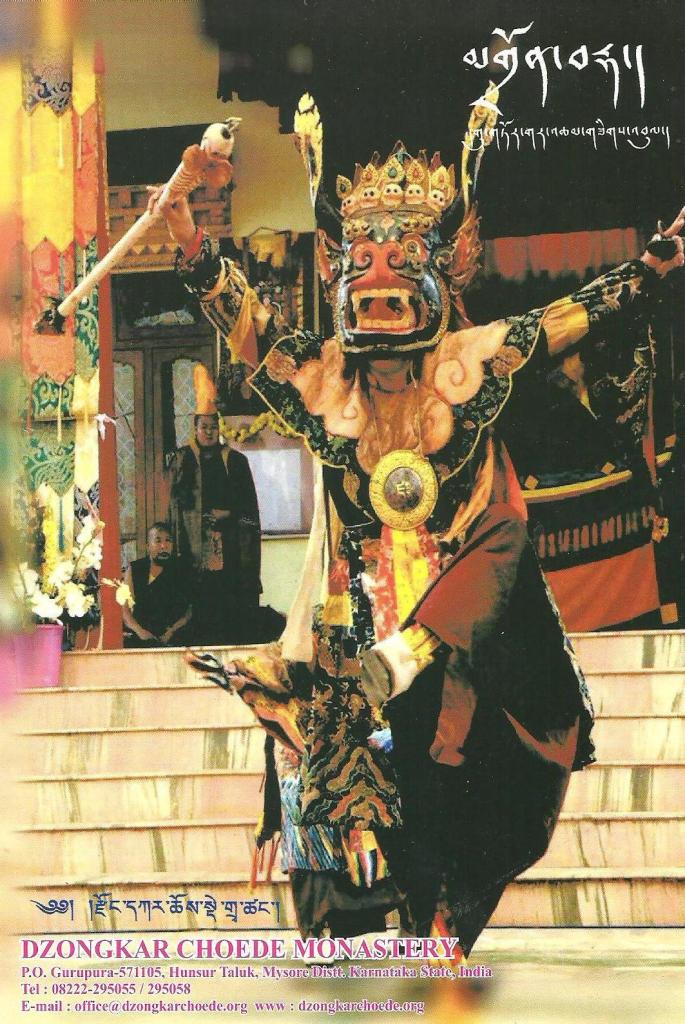
The lama dances or cham, are held according to the Tibetan calendar on the 29th day of the final month of the old year. Their primary purpose is to purify negativity, get rid of all the bad spirits which might still be around from the old year, so as to begin the new one afresh, slate wiped clean, with the culmination of the day’s activities being the burning of an effigy symbolising all that needs to be got shot of.
This was about the third or fourth year that we had made the trip together. To be honest Sonam Tashi and I usually call it a day after lunch and don’t stay for the afternoon part of the proceedings, both of us possibly having rather low boredom thresholds you see, but that is OK, because by that point we will have been there a full 4 hours and seen the main lama dance performances which always take place in the morning.
The location of the monastery and the huge awnings which are hung over the expansive courtyard in front of the main temple building all make for a particularly pleasant experience if you happen to be sitting in the guest section, especially if there is a nice cool South Indian breeze blowing across that part of the plains which comprise the settlement, which lies about 10 km or so west of the town of Hunsur, a place noted for the quality of its wood and timber. Hunsur Ply! Guests get to sit on chairs with a little table in front of them and naturally enough, from their elevated position at the top of the monastery entrance stairs and just in front of the main doors to the temple, they have a grand stand view of events as they unfold.
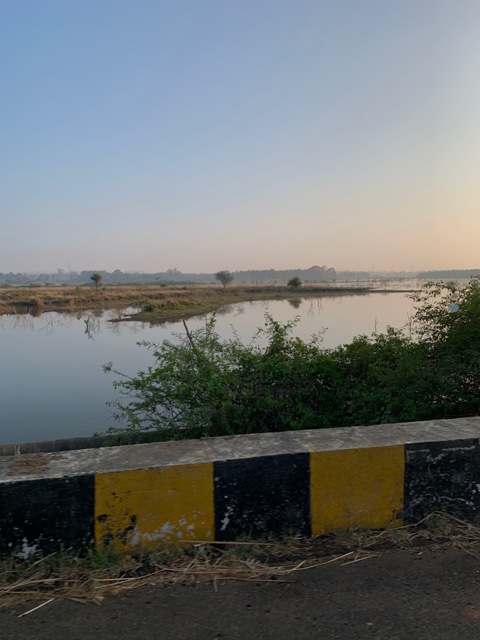
Driving over to Hunsur for the lama dances means a relatively early start from Bylakuppe – we are usually on the road by 7 – but that doesn’t mean we don’t stop for breakfast along the way. Yesterday we swung out around that time and went through the Indian village of Allanahalli which lies just at the edge of the TDL New Settlement. It is only recently that we have begun to go this way and our reason for doing so is that at last the Karnataka state government has finally made good the road which lies between Allanahalli and the highway. For many years before this momentous event, it was little more than a pot holed stump of a bone cruncher which was best avoided under any circumstances. This year however things are different, miraculously the money allocated for the long outstanding works hasn’t disappeared into the pockets of the local officials, so we more or less sped through the open fields past Allanahalli before emerging onto NH 275 in what seemed like next to no time at all.
Directly opposite our entry onto the highway from the direction of Allanahalli was a pretty decent looking new restaurant which according to Sonam Tashi, although admittedly he had yet to try it out, served up pretty good food, pure veg only, and which went by the name of ADIGA’S where underneath the sign were written the words – Fresh. Food. Fast. Well, that was keeping things simple, but still it sounded pretty good to me, so maybe one day we will go there, although a possible problem might be the location, because it is quite literally a little too close to home. By way of contrast, a little further on down the highway, was a place where they had got it all wrong, I mean really, who is ever going to call in at a place called Hotel Stop & Taste? When is the Hotel Stop & Taste ever going to pick up any Michelin stars? Just can’t see it happening somehow, but then again, you never know!
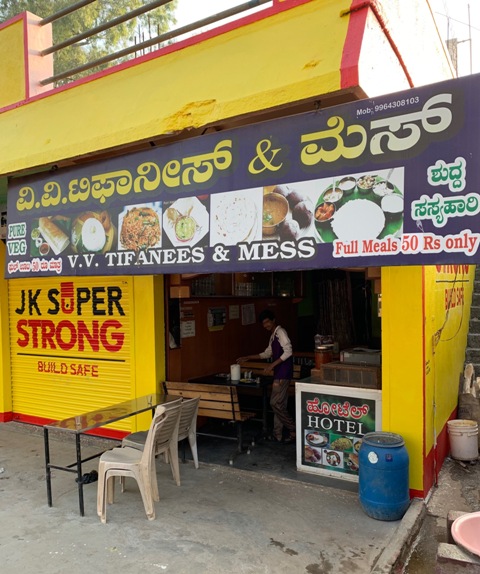
This time around on our short hop across the plains to Hunsur we went for breakfast at V.V. Tifanees & Mess in the town of Periyapatna on NH 275, where according to the billboard placed outside it they served – Full Meals. 50 Rs Only. Well it was a bit too early in the day for a full meal or anything like that, but a plate of iddlys and chutney cut through with red chillies plus a crispy dhal poori was a different story. All washed down with strong, sweet Indian coffee it served to make for a fine start to the day, being more than enough to keep us going until our lunch in the monastery of Dzongkar Choede.
Further on up the highway was the Hotel Palace Lodge just before the village of Kamlapura, an establishment which always looks decidedly empty, although recently it has begun to offer rooms on OYO so I guess it is possible things might change in that regard and they will pull in a few more punters. On the other side of Kamlapura – between it and the next highway village of Chilkunda – is the Chandan Canteen, an attractive little roadside stop where you can usually buy a pretty decent drinking coconut for something like 30 rupees. Past Chilkunda and just before turning off NH 275 into Hunsur is the Hotel Balaji Lodge which used to be called the Sri Balaji Hotel in years gone by, maybe the new name makes all the difference, and opposite to that is the Ravanna Restaurant, one of those roadside eat houses used by tourist buses and coaches which means that it only ever gets busy when one of them rolls in and all its passengers disembark, other than that it always looks empty and, quite frankly, not that good.
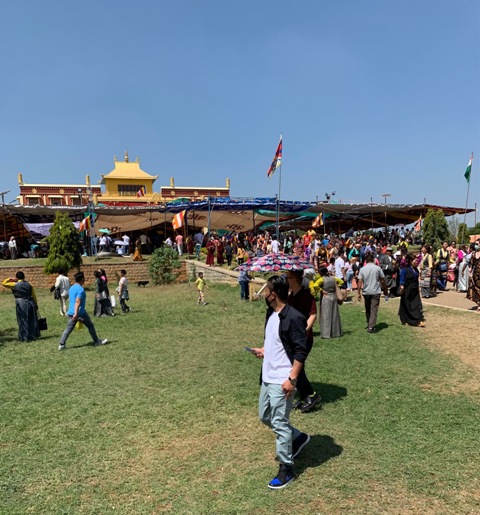
By the time we arrived at Dzongkar Choede Monastery it must have been around 8.15 and once we’d parked the Mahindra we were ushered into the visitors section by some smiling monks where we were guests. To the left of us Dzongkar Choede monks sat in rows blowing trumpets whilst others chanted. The smaller trumpets were called geyling and the larger ones, the ones which you see in books of Tibetan monks blowing from the rooftops of temples, and which can be both big and loud, were known as dum chen. Along with bells the other type of instrumentation used was by monks who had long handled drums which they tapped in rhythm with a thin curved stick and those drums were called na. Now, whilst it is doubtful I have as much faith in the efficacy and even religious significance of what is displayed before me as those Tibetans who find the whole event incredibly meaningful, I am still mindful that there is a power, beauty and grace to the lama dances which means the potential they have to positively affect those who come to witness them is going to be quite high.
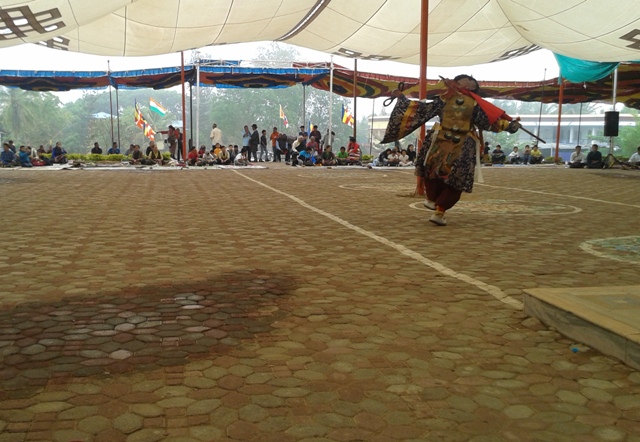
The main lama dances, cham, performed on this occasion were pretty much the same ones as in previous years namely –
Yak Dance – where the members of the audience have the opportunity to approach the dancing yak and offer khatas, white silk scarves, as signs of impending auspiciousness, or simple good luck. The dancing yak is operated by eight monks beneath the shell of its structure, the yak being an animal closely associated with Tibet, the Land of Snows.
Kinkara – is the dance of skeletons and the ritual of slaying a corpse which is symbolic of one’s negativities, and therefore it is a dance or rite of purification.
Palden Lhamo – dance of the divine female protector of the people of Tibet.
Tak Shel Ma – dance of the protector of Dzongkar Choede Monastery and therefore – at least as far as those close to the heart of Dzongkar Choede are concerned – probably the most important dance of all in terms of performing it successfully.
Snow Lions – the final dance of the morning is a pair of snow lions dancing acrobatically along with individual performers dressed in white to match the white colour of the snow lions. For many Tibetans snow lions have close associations with their homeland of Tibet, although this time, unlike the Yak, it is more mythical than real.
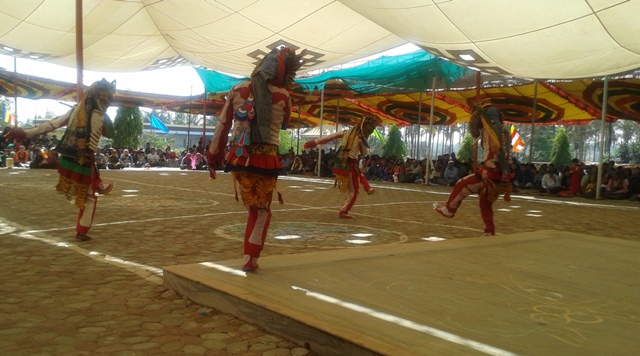
Kinkara
So the morning lama dances at Dzongkar Choede, as set lists go, is a pretty strong one and takes well over three hours to perform. There are plenty of other dances as well, but in correct running order the main ones listed above proceed as follows –
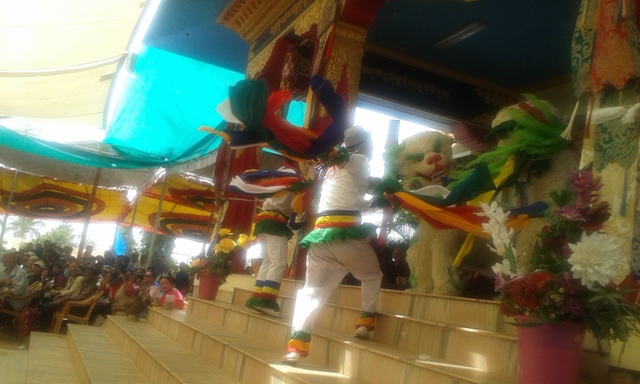
Snow Lions
It was really all so pleasant, sitting there with the fresh morning breezes rollin’ in from over the plains, the tent roof coverings and awnings fluttering above the heads of the performers and people beneath a blue sky full of sunlight. Just so relaxing, and not only that, as special guests we were spoilt too, with servings of either Tibetan tea or Indian chai, sweets and biscuits, cool drinks, small bowls of sweet rice called desi and bottles of water, all of which ensured we were very well looked after, the refreshments coming along as if in a never ending show. Even got to the point where whilst witnessing all spread before me I put pen to paper, or rather I tapped the following into the Notes page of my iphone –
days that you keep
nights when you sleep
tears which you weep
where the road gets steep
are what you sweep
into this heap of deep
Profound huh? Nah, not really.
By late morning – 11.45 or so – the first part of the cham was over and it was time to head to the guest room for lunch which as usual was an extremely tasty vegetarian buffet consisting of dishes such as masala mushrooms, vegetarian chow mien, vegetarian pasta, rice, ting mo, dhal, fresh curd, breads, fried bitter-gourd, fried aubergine and plenty more delicious fare.

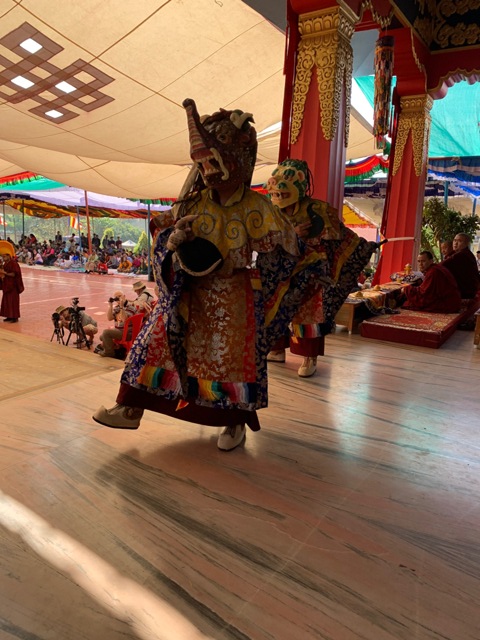

Protector
It was something like 12.30 – 12.45 when we got back in the car and made our way out of the monastery gates so as to return to the settlement, with there being a short stop for a glass of sweet chai thrown in at a place on the road just short of Hunsur which went by the name of Green Family Restaurant. So that was it then, another cham was over and I for one was very happy to have attended it which as I have mentioned, by hook or by crook, is now my third or fourth one in a row.
 TracelessTrails